An automatic car wash for a hot, dusty and water-conscious market should be configured around the local environment rather than selected from a generic equipment list. The most important decisions concern dust removal, wash chemistry, water quality, heat management, corrosion protection, drying, drainage and service access. A machine that operates well in a mild climate may require different supporting equipment and operating procedures at a site exposed to desert dust, intense sun, high ambient temperatures or coastal air.
This buyer’s guide explains what investors, car wash operators, gas stations, dealerships and distributors should confirm before ordering an automatic car wash for markets such as Saudi Arabia, the United Arab Emirates and other parts of the Middle East. It does not prescribe one configuration for every country or city. Final equipment, civil, electrical, wastewater and licensing decisions must be verified for the actual site.
Buyer summary: prioritize an effective prewash for dust and sand, test the local water, separate reclaimed-water and final-rinse duties, protect equipment from heat and corrosive air, and confirm peak throughput and service support before choosing the machine.
Why does climate affect automatic car wash selection?
The local environment changes both the soil on the vehicle and the conditions around the equipment. Fine dust can cover paint, glass, wheels and the underbody. Mineral-rich water may leave deposits on the vehicle and inside nozzles or pipes. Heat can affect electrical enclosures, pumps, chemicals and maintenance conditions. Coastal locations may also expose structural and electrical components to humid, salt-bearing air.
| Site condition | Possible project effect | What the buyer should confirm |
|---|---|---|
| Frequent dust and sand | Higher soil load on paint, wheels, sensors, floors and drainage | Prewash process, grit removal, underbody option, cleaning schedule and drainage access |
| High ambient temperature | Higher thermal load in equipment rooms and electrical cabinets | Ventilation, shade, operating-temperature limits and local cooling requirements |
| Hard or mineral-rich water | Scale, nozzle deposits, chemical inconsistency and visible spotting | Water analysis, filtration, softening and final-rinse treatment |
| Water-use constraints | Need to control fresh-water demand and wastewater volume | Wash-program water balance, reclamation stages, make-up water and discharge plan |
| Coastal or corrosive air | Accelerated corrosion of exposed structures, fasteners and enclosures | Materials, coatings, inspection intervals, washdown and preventive maintenance |
| Outdoor or partially open bay | Sun, wind and airborne dust affect vehicles and equipment | Canopy, enclosure, drainage, equipment protection and post-wash dust exposure |
The quotation should therefore describe more than the machine model. It should identify the assumptions about climate, water, vehicle mix, bay design and operating schedule that support the proposed configuration.
Design the prewash for dust and sand
Heavy loose dust should be removed before the finishing stages of the wash. If sand remains on the surface, cleaning quality becomes less predictable and any physical contact must be managed carefully. The wash process may combine a controlled chemical pre-soak, suitable dwell time, high-pressure rinsing and targeted wheel, rocker-panel or underbody cleaning where the selected equipment supports those functions.
More pressure is not automatically the complete answer. Nozzle position, distance, spray pattern, water flow, chemical compatibility, vehicle detection and program timing work together. Ask the supplier to explain how the machine follows the vehicle profile, how it handles pickup trucks and SUVs, and which stages can be adjusted for lighter or heavier soil.
- Confirm whether pre-soak and high-foam stages are separately adjustable.
- Review wheel, rocker-panel and chassis-cleaning options for the intended vehicle mix.
- Provide accessible sediment traps or collection points before sand reaches pumps and treatment equipment.
- Plan a cleaning schedule for sensors, bay floors, drainage channels and exposed equipment.
The objective is a repeatable process that removes loose contamination early, preserves the effectiveness of later chemistry and prevents excessive grit from circulating through the site.
Touchless, rollover or tunnel: which format fits the environment?
Climate does not determine the machine category by itself. Site dimensions, required throughput, service concept and customer expectations remain the main selection factors. However, dusty conditions change the questions buyers should ask about each format.
Touchless in-bay systems
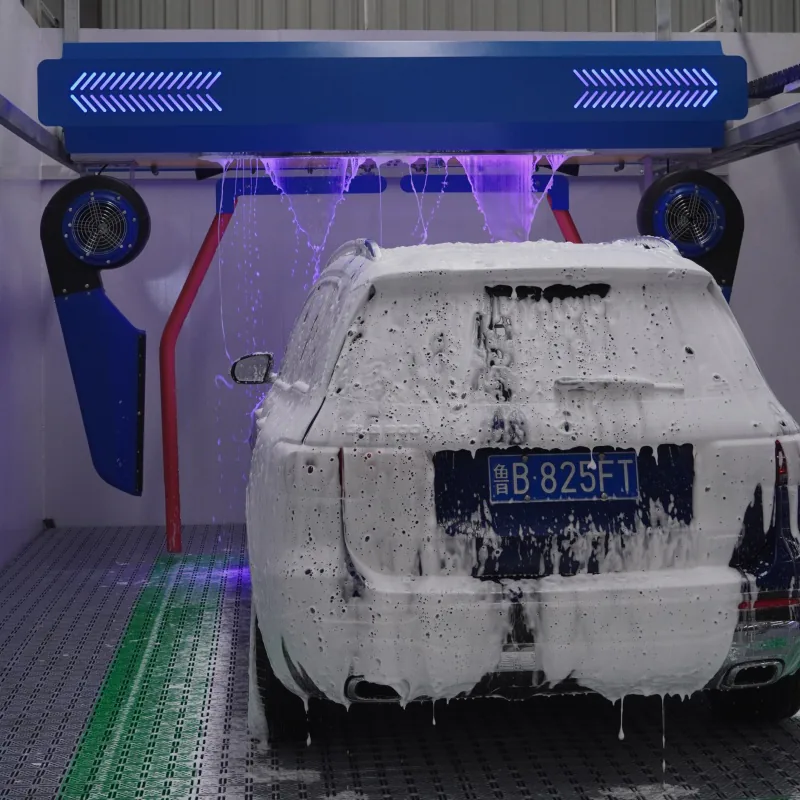
A touchless system uses high-pressure water and programmed chemical stages without brushes contacting the vehicle body. This may suit operators who want a contact-free service, but cleaning performance still depends on removing loose dust, providing suitable chemistry and maintaining the correct water and nozzle conditions. Confirm vehicle profiling, pre-soak control, wheel and underbody options, drying configuration and the treatment required for the water supply.
Rollover brush systems
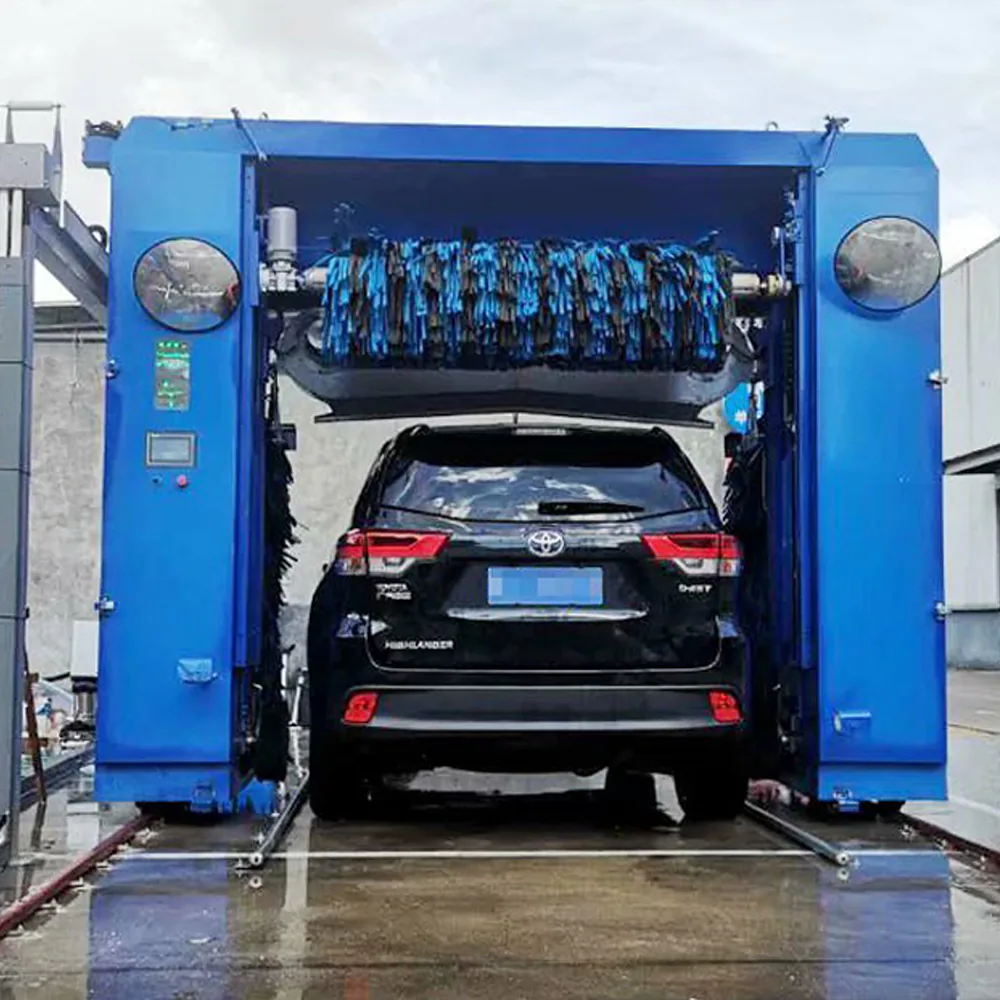
A rollover system adds mechanical cleaning through soft-foam brushes while the gantry moves around a stationary vehicle. For dusty markets, buyers should pay particular attention to the pre-rinse, brush rinsing and cleaning routines, because trapped grit should not be allowed to accumulate on contact components. Confirm the brush material, contour control, wash sequence, brush-maintenance procedure and replacement plan.
Conveyor tunnel systems
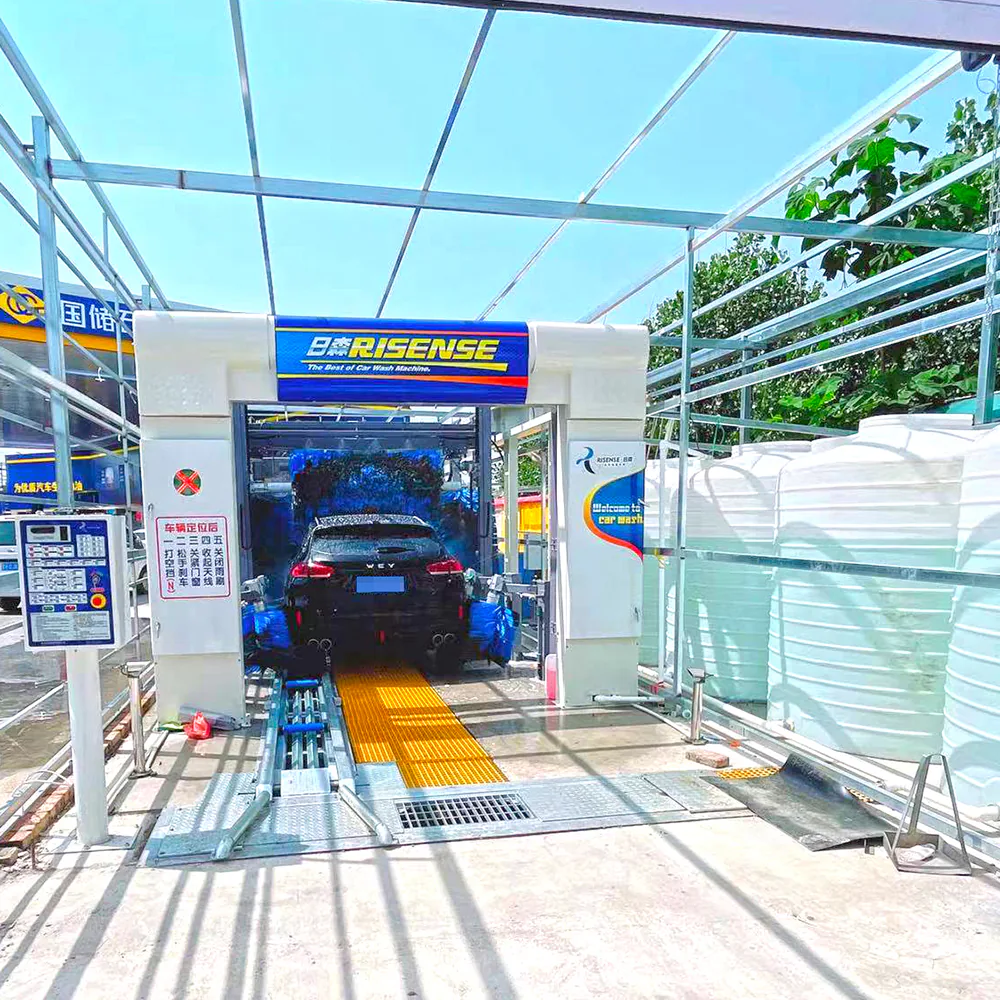
A tunnel separates washing into multiple stages and can support sustained traffic when the property and business model justify it. Dust removal can be assigned to dedicated early modules before the vehicle reaches brushes or finishing stages. The project must also provide sufficient queue length, drainage capacity, equipment-room space and water-treatment flow for peak operation.
Use the touchless, rollover and tunnel comparison for a broader operating comparison, then review the current YOLO automatic car wash equipment range against the actual site.
Test the water before specifying treatment equipment
Water that looks clear can still contain dissolved minerals that affect the wash. A project should not add a softener, filter or reverse-osmosis system simply because another site uses one. Treatment should be based on a representative water analysis, the machine requirements and the quality needed at each wash stage.
Ask the local laboratory or responsible utility professional to report the parameters required by the water-treatment designer. Depending on the project, the review may include hardness, total dissolved solids, suspended solids, pH, conductivity, chlorides and other relevant indicators. The treatment supplier should then explain the design flow, storage, consumables, regeneration or membrane maintenance, reject water and monitoring requirements.
| Water duty | Typical quality priority | Planning question |
|---|---|---|
| Underbody and early pre-rinse | Reliable solids control and compatibility with pumps and nozzles | Can approved reclaimed water be used at this stage? |
| Main washing and chemical stages | Stable hardness, pH and chemical performance | Will local water change dosing or create scale? |
| Brush or equipment rinsing | Low grit load and consistent flow | How will solids be prevented from returning to contact components? |
| Final rinse or spot-free finish | Low dissolved-mineral carryover appropriate to the desired finish | Is softened, demineralized or reverse-osmosis water required? |
A spot-free rinse is a finishing function, not a replacement for the complete wash-water and wastewater design. Its capacity should be based on peak demand, the recovery rate of the selected treatment system, storage volume and the number of final-rinse cycles.
Separate water conservation, reclamation and final rinse
These three decisions are connected but not identical. Efficient nozzles and programmed cycles can reduce water use. A reclamation system can collect and treat used wash water for approved reuse stages. A final-rinse system can provide higher-quality water for the last stage. One piece of equipment does not automatically perform all three functions.
In water-conscious markets, prepare a complete water balance showing fresh-water input, reclaimed-water reuse, losses, filter backwash, sludge removal, treatment reject and permitted discharge. The published recycling percentage of a component should not be presented as the guaranteed reduction in the site’s water bill. Actual savings depend on the wash programs, vehicle volume, soil load, treatment condition and operator practice.
The detailed car wash water recycling guide explains collection, separation, filtration, storage and reuse in more detail.
Protect equipment and chemicals from heat
Ambient heat outside the bay can become more severe inside an enclosed technical room or electrical cabinet. The equipment supplier should state the operating-environment limits for the supplied components, while the local engineer determines the ventilation, shading or cooling required at the site.
- Locate electrical panels and chemical storage away from direct solar exposure where practical.
- Provide technical-room ventilation and maintenance clearance based on the equipment heat load.
- Confirm pump, motor, sensor, display and cable ratings for the expected environment.
- Store chemicals within the temperature range stated by their supplier and safety documentation.
- Protect outdoor pipes, hoses, seals and displays from sunlight and inspect them at defined intervals.
Do not assume that a larger fan or air conditioner solves every heat issue. Enclosure design, air intake location, dust filtration, heat rejection and access for filter cleaning must be considered together.
Plan corrosion protection for coastal and wash-bay exposure
Wash equipment is exposed to water, chemicals and repeated wet-dry cycles. Coastal sites may add humid, salt-bearing air. Buyers should ask for a written description of structural materials, surface treatment, fasteners, electrical-enclosure protection and required maintenance rather than relying on the word “corrosion-resistant” alone.
The local maintenance plan may include fresh-water washdown of specified surfaces, inspection of coating damage, cleaning around drains, protection of electrical connections and timely replacement of damaged seals or fasteners. Any repair coating or chemical should be compatible with the original material and supplier instructions.
Drying still matters in a hot climate
High outdoor temperature does not guarantee a clean, spot-free finish. Water may remain around mirrors, trim, wheels and recessed panels, while dissolved minerals can leave marks as droplets evaporate. Wind can also carry dust back to a wet vehicle after it exits the bay.
Compare drying configurations by confirmed fan arrangement, vehicle coverage, program time, electrical demand, noise management and exit conditions. The buyer should also decide whether the service promise is partial drying, a standard automatic finish or a premium result supported by final-rinse treatment and additional finishing work.
Confirm power, controls and unattended operation locally
Do not order a machine from a country-level voltage assumption. Obtain the site’s confirmed voltage, phase, frequency, available load, grounding arrangement and protection requirements from qualified local professionals. The quotation should identify the electrical configuration being supplied and separate machine scope from the buyer’s local distribution and connection work.
For unattended or extended-hour operation, consider more than the start button. The system may need clear Arabic and English instructions, vehicle-position guidance, emergency-stop access, camera coverage, remote fault information and a defined response when payment succeeds but a wash cannot begin. Any card, code, RFID or payment interface must be confirmed for compatibility with the chosen local system.
Wastewater and permits are location-specific
Saudi Arabia’s official small-business guidance recognizes both conventional and automatic car washes, while the Saudi Water Law defines car-wash water within its treatment and water-management framework. In the United Arab Emirates, requirements can vary by emirate and activity. Abu Dhabi’s Department of Energy publishes trade-effluent and recycled-water frameworks, and Dubai law prohibits discharging vehicle-washing water onto pavements or roads.
These examples show why drainage and treatment must be reviewed before installation; they do not create one permit checklist for the entire region. Confirm the responsible licensing, municipality, environmental, water, sewer, civil-defense and utility authorities for the exact address. The locally approved wastewater plan should be coordinated with the machine layout before civil work begins.
A supplier layout explains how the equipment should be installed. It does not replace local environmental, building, electrical or operating approval.
Information to send before requesting a configuration
A useful quotation for a hot and dusty market should begin with verified site information:
- Country, city and exact project location
- Available bay and site dimensions, including entrance and exit
- Current photographs, site plan and a short vehicle-flow video
- Expected vehicles per day and peak vehicles per hour
- Vehicle mix, including maximum SUV or pickup dimensions
- Typical soil conditions and required wash programs
- Water source, available flow and pressure, storage and laboratory analysis
- Existing drainage, wastewater treatment and permitted discharge route
- Confirmed voltage, phase, frequency and available electrical capacity
- Bay enclosure, shade, technical-room ventilation and coastal exposure
- Attended or unattended operating model and payment requirements
- Installation responsibility, target opening date and local service capability
YOLO Car Wash Systems can use these details to compare suitable touchless, rollover and tunnel configurations. Final specifications and local works are confirmed for each project. Send your site information to request a project recommendation.